
Most organizations aren’t short on marketing activity. They’re short on agreement about what it’s all for. And that gap usually stays hidden until everyone is in the same room, trying to plan around it.
That’s why your Marketing Blueprint doesn’t start in the room. It starts a week or two earlier, with our Marketing Organizer. It’s the homework we ask every person on your team to complete before your Blueprint Session, and honestly, it’s one of our favorite tools. When it’s done well, we walk in already knowing where your team agrees, where things are fuzzy, and where people are picturing completely different things. So we spend our time together building your plan instead of discovering why you need one.
What the Marketing Organizer Is
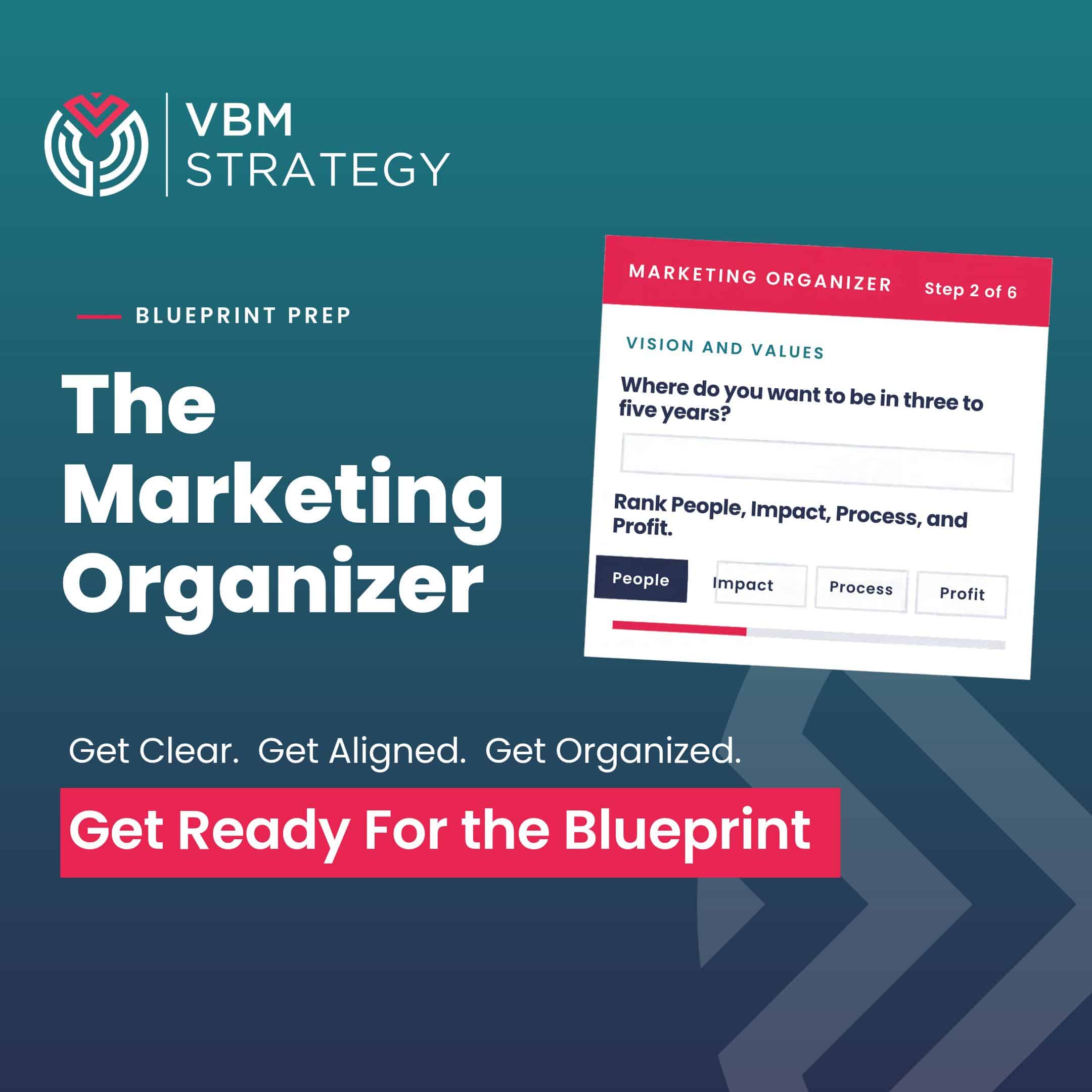
The Marketing Organizer is a six-step questionnaire that captures everything about your organization that shapes your marketing: where you’re headed, what you value, who you serve, what you’re already doing, and what you can realistically invest.
It’s built on the same frameworks we use in every Blueprint Session, including our Vision Value Model™ and PiPP (People, Impact, Process, Profit). So your answers don’t sit in a file somewhere. They become the raw material for your Blueprint, and later for the Foundational Content your team will use again and again.
The six steps:
- Your Organization. What you offer, your greatest challenges overall and in marketing, and what makes you different.
- Vision and Values. Where you want to be in three to five years, what you want to do for the people you serve, and how you rank People, Impact, Process, and Profit.
- Goals and SWOT. Your top three goals for the next 12 months, how you measure and celebrate success, and your strengths, weaknesses, opportunities, and threats.
- Audience and Brand. Who your primary audience is, what keeps them up at night, what stands in their way, and how you’d describe your brand if it were a person.
- Marketing, Networking, and Growth. Your content, newsletter, distribution, events, paid advertising, follow-up process, referrals, and onboarding. In other words, everything you’re already doing, so we can build on what’s working instead of starting over.
- Numbers That Matter. Revenue or funding, marketing budget, the hours your team can give to marketing, and what growth looks like for you.
- Marketing Skills Assessment. Get clear about who on your team (or your outside vendors) owns each marketing skill and identify the gaps.
How to Use It
You don’t have to finish it in one sitting. Your answers save as you go, and “Save and Continue Later” lets you come back when you have more time or need to track something down. A few tips that make your answers a lot more useful:
Block real time for it. Most people need 60 to 90 minutes. Treat it like a meeting with yourself, not something to squeeze in between calls.
Answer honestly, not perfectly. There are no wrong answers. “I’m not sure” and “we don’t really have a process for that” are some of the most useful things you can tell us. Blank spots show us exactly where to focus.
Be specific. “Grow our audience” is hard to build a plan around. “Add 40 new monthly donors” or “book 12 new clients from referrals” is something we can plan for, measure, and celebrate.
Lean into the SWOT. Strengths, weaknesses, opportunities, and threats are easy to rush. Give this one a few extra minutes. Your weaknesses and threats often point straight to your biggest marketing opportunities.
Describe your audience like a real person. Go beyond demographics. What worries them? What are they trying to accomplish? What stops them from saying yes? The more human your answers, the stronger your messaging will be.
Be candid about your numbers. Budget and available hours are required for a reason. The best strategy in the world won’t help if it depends on a team or budget you don’t have. We build plans that fit your real capacity, then adjust them every 90 days as things change.
Why It Needs to Happen Before Your Blueprint Session
Your Blueprint Session is a working session with your leadership and marketing team at the same table. If the first hour goes to explaining what you do, who you serve, and what you’ve already tried, that’s an hour not spent building your plan.
When the Organizer is complete ahead of time, three things happen.
We arrive prepared. We review every response before the session, so we walk in knowing your goals, your audience, your current marketing, and your constraints. That lets us go straight to the conversations that matter most.
Your team arrives prepared, too. Answering these questions makes you slow down and think. Many clients tell us the homework itself sparked conversations they hadn’t had in years. You walk in with clearer thinking, not just a calendar invite.
The session goes deeper. Instead of gathering information, we spend the time connecting your vision to your goals, your goals to your audience, and your audience to a 90-day plan your team can actually run with. That’s how a Blueprint becomes a plan people use, not a report that lives in a drawer.
Why Every Person at the Table Completes Their Own
This is the part that surprises people. We don’t want one Marketing Organizer from your team. We want one from every person who will be in your Blueprint Session, each completed on their own.
We know, it feels like extra work. Wouldn’t it be easier for one person (usually the marketing person) to fill it out for everyone? Easier, sure. But you’d lose the most valuable thing the Organizer reveals.
Alignment isn’t something you can assume. Leaders who work side by side every day often hold very different pictures of the organization. One person thinks the top goal is growth. Another thinks it’s stability. One sees the ideal client as a large organization. Another is picturing someone completely different. Nobody is wrong. They’ve just never compared notes. And the marketing team is usually the one caught in the middle, trying to deliver on all of it at once.
Independent answers bring those differences to the surface. When we put everyone’s responses side by side, we look for two things:
- Areas without clarity. Questions where answers are vague, inconsistent, or left blank. These usually point to something that hasn’t been defined yet, like who the primary audience really is or how success gets measured.
- Areas of real disagreement. Questions where people give confident but conflicting answers. Different top goals. Different value rankings. Different views of your biggest weakness or opportunity.
Those gaps become the agenda. We bring what we find into the session so your team can work through it together with a facilitator in the room. Disagreement isn’t a problem to hide. It’s information. Priorities get debated, decided, and agreed on right there, so when your Blueprint arrives, nobody is wondering what’s in it. They helped build it. And plans get used when the people running them believe in them.
It keeps every voice in the room. When one person fills out the Organizer, the strategy reflects one perspective. When everyone does, the people closest to your clients, your programs, and your day-to-day marketing all get heard. That’s often where the insights leadership needs most are hiding. It also means your marketing person is no longer the only one holding the whole picture together.
One request: please don’t compare answers before you submit. Each person’s honest, unfiltered view is the whole point.
Not Ready for a Blueprint Yet? Use It Anyway.
The Marketing Organizer was built as Blueprint homework, but it works on its own, too. Even if a Blueprint Session isn’t on your calendar yet, working through it gives you something most organizations don’t have: everything about your marketing in one place.
A few ways to put it to work:
- Get it out of people’s heads. Vision, values, goals, audience, and budget often live in scattered notes, old decks, and somebody’s memory. The Organizer pulls it all together.
- Check in on your team’s alignment. Have your leadership and marketing team complete it separately, then compare. You’ll quickly see where you’re on the same page and where you need a conversation.
- Bring new people up to speed. A completed Organizer is a fast way to brief a new marketing hire, board member, ad agency, or freelancer, so everyone starts from the same place.
- Spot your gaps. Questions you can’t answer yet, like how you follow up after an event or how you onboard new clients, show you exactly where your marketing needs attention.
- Revisit it every year. Your answers will change as your organization grows. Comparing this year’s responses to last year’s is a simple way to see how far you’ve come.
And when you are ready for a Blueprint, you’ll already have a head start.
Start With the Homework
Random acts of marketing usually start with questions nobody has answered together. The Marketing Organizer asks them. Completing it before your Blueprint Session, with every person at the table answering on their own, is the single best thing you can do to make that time count.
If your Blueprint Session is on the calendar, look for the Marketing Organizer link in your welcome email and get started today. Not there yet, but ready to turn random acts of marketing into a plan your whole organization can get behind? Reach out. We’d love to send it your way.