How clearer roles, stronger accountability, and the right marketing systems create room for better results.
Ever feel like your team is doing all the things, but somehow the priorities keep shifting, decisions take longer than they should and everyone is a little unclear about who owns what?
We get it. Because we’ve been there.
At VBM Strategy, we spend a lot of time helping marketing teams build the strategies and systems that make their work more effective. But recently, we found ourselves needing to take a little of our own advice.
The Problem: Too Many Shared Responsibilities, Not Enough Ownership
As we’ve built VBM Strategy over the years, shared responsibility became a regular part of how we operated. We collaborated on everything from marketing and business development to operations and financial decisions.
And while collaboration is one of our strengths, we started noticing something.
When everyone had a hand in something, no one person was necessarily accountable for the whole thing.
We were duplicating efforts. Spending meeting time realigning on responsibilities. And spreading our priorities across so many aspects of the business that we were running into that familiar problem:
When everything is a priority, nothing really is.
Sound familiar?
It’s something we see with marketing teams, too. The issue isn’t necessarily a lack of talent, effort or even resources. Sometimes it’s that the people doing the work don’t have a clear system defining who owns what, where decisions happen and how everyone stays accountable to the bigger picture.
The Shift: Creating Our Own Support Map
One of the things we value most about the clients we work with is their appreciation for systems, processes and intentional operations.
So we stepped back and examined our own.
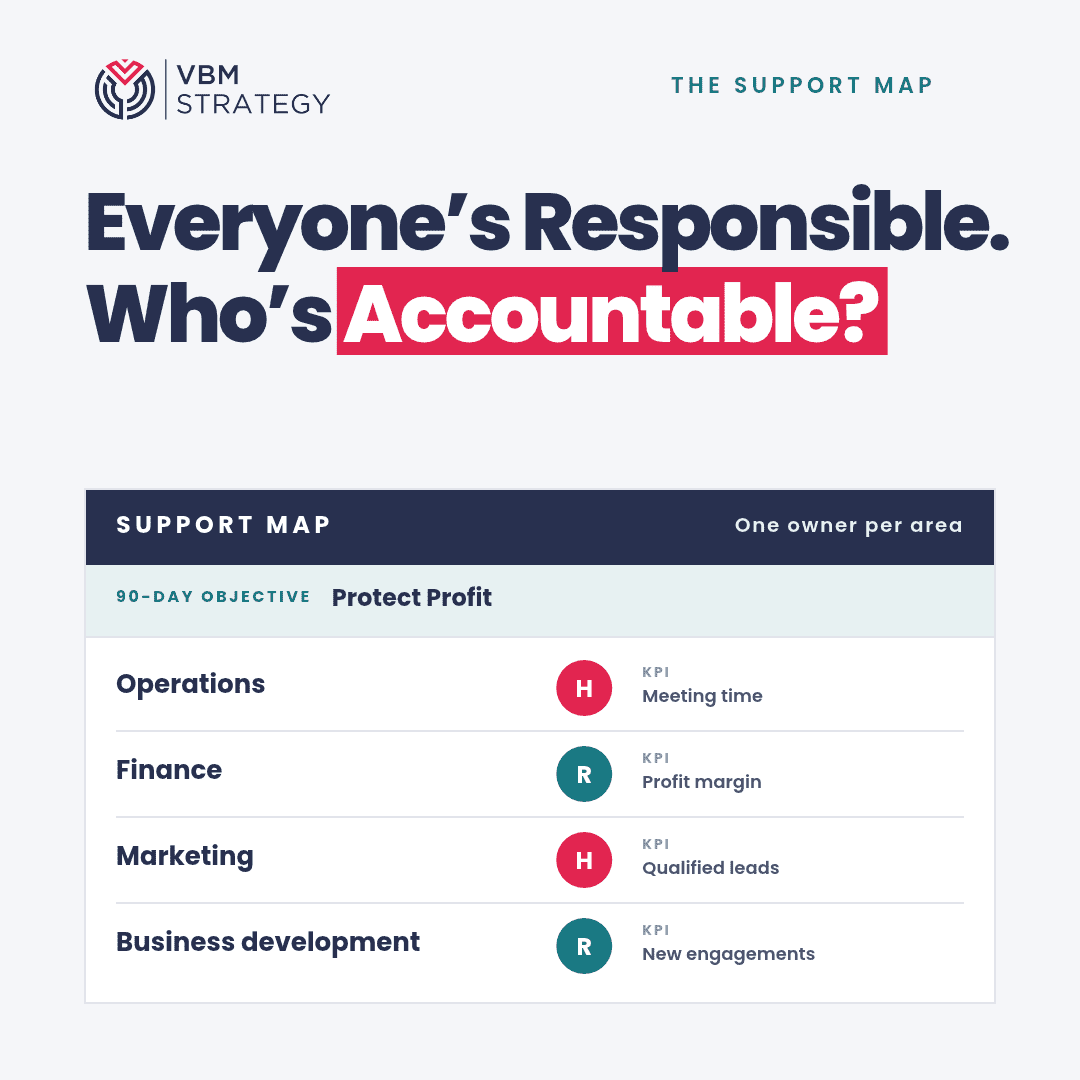
We began formally dividing responsibilities across key areas of our business, including operations, finance, marketing and business development. Each area would have one clearly designated owner.
That didn’t mean collaboration stopped or that someone else couldn’t contribute to a project. It meant there was one person ultimately responsible for moving each area forward.
And something started happening almost immediately.
Our meetings became more efficient because we weren’t constantly revisiting who was responsible for what. Decisions became easier because we knew where they belonged. And we were able to establish more meaningful KPIs tied directly to our business priorities.
For us, one of those priorities is profitability.
As we move through our next 90-day foundational sprint, we’re intentionally protecting the Profit component of our PiPP framework: People, Impact, Process, and Profit.
We love innovation. If you know our team, you know there’s never a shortage of new ideas. But innovation can’t consistently come at the expense of profitability.
Clarity around ownership gives us the structure to protect what matters most while creating more room for creativity and growth.
The Solution: A Support Map That Connects People, Priorities and Performance
This experience reinforced something we’ve been building into our client work: our Support Map System.
When we develop a Marketing Blueprint with a client, we start with the bigger vision. What growth, transition or change is the organization working toward? What matters most along the way? And what needs to happen in marketing to support it?
From there, we move into the 90-Day High-Impact Plan, where strategy begins turning into actionable systems.
One of those foundational systems is the Support Map.
It’s designed to create clarity around:
- Ownership: Who is ultimately responsible for each key marketing function or priority?
- Roles: What belongs to the internal marketing team, leadership, VBM or other specialist partners?
- Accountability: Who is responsible for keeping work moving, making decisions and tracking progress?
- Performance: Which KPIs help us measure whether the work is actually supporting the organization’s goals?
It’s not about adding another complicated process or creating more meetings.
It’s about making the work easier to move forward.
And here’s the part that doesn’t always show up on a dashboard: The relief a team feels when everyone knows their lane.
When people understand what they own, who they can turn to and how their work connects to the larger strategy, there’s less second-guessing. Less duplicated effort. Fewer competing priorities.
And more space for the things that make marketing valuable: creativity, problem-solving, innovation, and meaningful results.
Heading Into 2027: A Little Less Reactive. A Lot More Intentional.
As we begin planning for 2027, the Support Map System is something we’re celebrating internally and continuing to prioritize with our clients.
Because even teams that understand strategy can slip into reactive mode when things get busy. We certainly did.
The difference is having a strategy and a system that brings everyone back to what matters most.
Sometimes the biggest opportunity for better marketing ROI isn’t another campaign, another platform or another person.
Sometimes it’s getting the right people aligned around the right priorities, with clear ownership and accountability to move the work forward.
We’re seeing what that shift can do for our own business. And it’s exactly the kind of clarity we want the marketing teams we work alongside to experience.
Curious what a Support Map could look like for your marketing team?
Let’s connect and talk about how clearer roles, accountability, and marketing systems could help your team move into 2027 with more confidence and direction.