How to Use Foundational Content Across Every Marketing Effort
Most organizations aren’t short on marketing activity. They’re short on agreement about what it all says.
If you’re the person who owns the marketing seat, you know how this goes. Sales describes the company one way. The director describes it another. The website says something from three years ago, and the proposal your BD lead sent last week says something else entirely. Then a new request lands on your desk and you start from a blank page. Again.
That isn’t a talent problem or an effort problem. It’s a foundation problem. When there’s no shared, written language for who you are and why it matters, every blog, deck, email, and social post becomes its own little project. We call that random acts of marketing, and foundational content is how you stop them.
What foundational content actually is
Foundational content is the approved, written language your whole organization uses to explain who you are, who you serve, what problem you solve, and why anyone should care. It turns your strategy into words people can actually use.
It also shifts the conversation from you to them. “We’ve been in business for 20 years” is a fact. “We help growing firms stop depending on one person to hold all the marketing together” is a reason to care. Foundational content does that translation once, so nobody has to reinvent it on deadline.
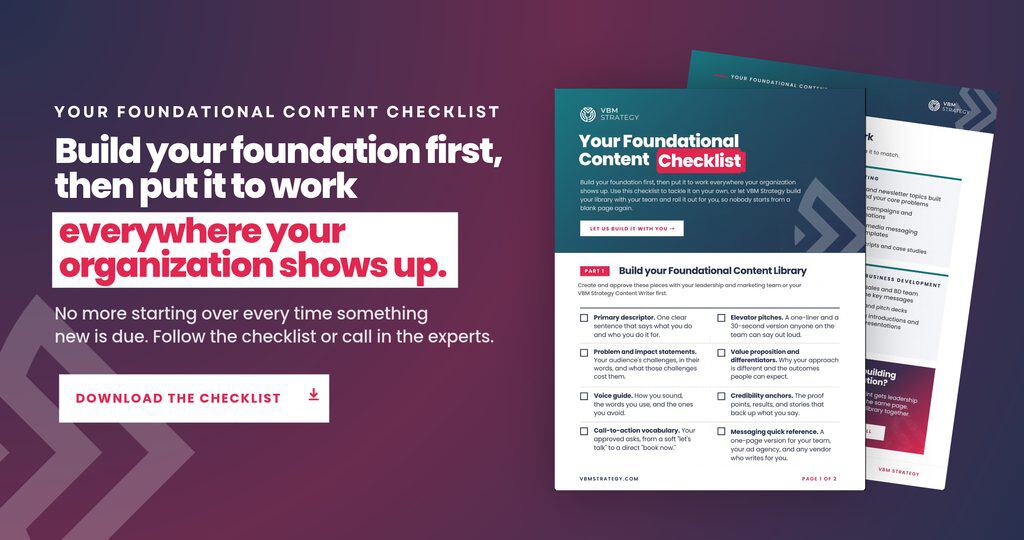
At VBM Strategy, we build it as a Foundational Content Library. It’s one of the six systems we put in place with every client, and it typically includes:
- Primary descriptor: the one clear sentence that says what you do and for whom
- Elevator pitches: a one-liner and a 30-second version anyone on the team can say out loud
- Problem and impact statements: the challenges your audience faces, in their words, and what it costs them
- Value proposition and differentiators: why your approach is different and what outcomes people can expect
- Voice guide: how you sound, the words you use, and the ones you avoid
- Credibility anchors: the proof points, results, and stories that back up what you say
- Call-to-action vocabulary: your approved asks, from the soft “let’s talk” to the direct “book now”
- Messaging quick reference: a one-page version for your team, your ad agency, and any vendor who writes for you
We build all of it with your team, not for them. The words have to sound like you when your people say them, or they won’t get used.
Strategy first. Foundation second. Everything else third.
Foundational content is usually the first thing we build after the Marketing Blueprint, because the Blueprint decides what needs to be said and the foundation decides how to say it.
The Blueprint is month one of our engagement. Your leadership and marketing team sit at the same table, and we use our Problem Solver Method to get clear on the real problems your audience faces, why those problems matter, and how you solve them. That clarity is the raw material. Foundational content turns it into language your team can pick up and use on Monday.
Skip the foundation and the strategy tends to stall. It lives in a slide deck or, worse, a drawer. Build it, and every priority in your 90-day plan has words ready to carry it. We’ve seen it work the same way for a professional services firm, a nonprofit getting ready for a big campaign, and a family business relaunching its website: no tactic launched until the message was approved, and everything that came after moved faster because of it.
And no, it doesn’t mean starting over. We work from what you already have, keep what’s working, and close the gaps.
Where Your Foundational Content Goes to Work
Once the library exists, the question stops being “What should we say?” and becomes “How do we say it this time?” That one shift saves an enormous amount of time and second-guessing.
Your website
Your website should be the first public expression of your foundational content, not the place where messaging gets invented. Start with the homepage, About page, service or program pages, and your main calls to action. A beautiful redesign built on fuzzy messaging is still fuzzy.
Your AI tools
AI is great at expanding, repurposing, and organizing content. It is not great at deciding what your message should be. Instead of asking it to “write a blog about leadership,” give it your primary descriptor, audience problems, differentiators, and voice guide. Now it’s building from your strategy instead of guessing, and the result sounds a lot more like you and a lot less like everyone else.
Your sales and business development team
When sales, BD, and leadership all work from the same language, prospects get the same story no matter who they talk to. Proposals shift from a pile of features and history to the problems you solve and the outcomes clients care about. Consistency builds trust, and trust is what moves people to say yes.
Presentations, networking, and speaking
A talk at a conference, a workshop, or your intro at a chamber event all start from the same core talking points. You’re no longer building from scratch. You’re choosing which part of the story fits this room.
Your content calendar
Blogs, emails, newsletters, social posts, videos, and case studies all get easier and faster. Your team pulls from approved messages instead of debating them every time a draft goes around.
New team members
New hires often spend months figuring out who you serve and how to talk about what you do. A foundational content library hands them that on day one, so they can speak confidently sooner.
Your marketing person’s sanity
This one is real. When leadership has already signed off on the message, the person in the marketing seat stops defending every word and starts moving the work forward. It also gets a lot easier to say “great idea, let’s put it in next quarter.”
Turn random acts of marketing into momentum
Most teams jump straight to tactics: a new website, a new campaign, a new tool. Those tactics work a lot better when they’re standing on something solid.
If your marketing feels inconsistent, your website isn’t saying what you mean, or your team keeps recreating the message every time something new is due, it may be time to build your foundation. Let’s talk about your goals, your team, and whether a Marketing Blueprint or a Foundational Content Library is the right next step.